

Fitting a new balustrade is one of those home improvement projects that sounds more complicated than it often turns out to be. The question most homeowners ask before committing is a sensible one: Can I actually do this myself, or will I need to bring in a professional?
The honest answer is that it depends far less on your skill level than on the kit you choose. Balustrade installation difficulty varies enormously depending on how well a product has been engineered and prepared before it reaches your door. Some kits genuinely are straightforward for a capable DIYer. Others use the word “DIY” loosely, and only reveal their complexity once you’re partway through the job.
This guide walks through the key features that separate a genuinely DIY-friendly balustrade kit from one that merely claims to be.
Most people researching balustrade options are not professional joiners. They are homeowners who want a better-looking, safer staircase without the disruption and cost of a full replacement or a lengthy trade quote process.
The market has responded to this with a wide range of kit-based balustrade products, but the quality and usability of those kits vary considerably. Understanding what DIY-friendly balustrade features actually look like in practice means you can assess any product against a clear set of criteria, rather than relying on marketing language alone.
This is arguably the single most important thing to look for in a balustrade kit, and it is the feature that makes the biggest practical difference on installation day.
A pre-cut kit means handrails, base rails, and balustrade infills arrive sized to fit your specific staircase, rather than requiring you to cut components down on-site. Pre-cut balustrade components remove one of the most technically demanding parts of the job from the installer entirely.
A made-to-measure kit takes this further. Rather than being sized to approximate dimensions, every component is built to the exact measurements of your staircase. This means:
Pre-drilled handrails arrive with fixing holes already placed at the correct positions and angles during manufacture. On a staircase, where nothing is perfectly horizontal and angles change between runs, this preparation makes a real difference.
Without pre-drilled components, the installer is responsible for:
Getting any of these wrong can mean fixings that do not pull tight, components that sit at the wrong angle, or a finished result that looks uneven. A kit where this work has already been done removes that risk entirely.

Good fitting instructions are not a bonus — they are a core part of what makes a balustrade kit achievable for a non-professional. A well-designed product with poor instructions will still frustrate most DIYers.
Not all balustrade fitting instructions are equal. When assessing a kit, look for:
Instructions that assume prior knowledge, skip steps, or use unclear diagrams add difficulty to a project that should be straightforward.
Video guides have become an increasingly valuable part of the DIY balustrade fitting process. Being able to watch a particular step being carried out — securing glass panels, fixing a newel post, or checking angles — is often more useful than a written description alone.
A supplier who provides thorough online video guides as part of their stair balustrade fitting guide is giving DIYers a genuine advantage. Look for:
Some manufacturers offer video call support either during the measuring process before you order, or during fitting if a question arises. This kind of direct guidance significantly reduces the risk of errors, particularly for first-time installers. It is worth checking whether this is available before committing to a purchase.
One of the most common concerns about fitting a balustrade is whether specialist tools are required. It is worth being direct about this.
A well-designed balustrade kit should be installable using tools most homeowners already own. The typical balustrade tools required for a stair kit installation are:
That is it. If a kit’s instructions call for any of the following, it is not genuinely DIY-friendly for the average homeowner:
The tools a kit requires tell you a lot about how thoroughly it has been prepared at the manufacturing stage. A kit that needs angle grinding or on-site cutting is one where preparation work has been left to the installer rather than completed by the manufacturer.
A kit that can be fitted with a drill and a spirit level is one that has been engineered with the DIY installer in mind from the start.
Accurate measuring is often the part of the process that homeowners feel least confident about — and with good reason. Staircases are not straightforward to measure.
Unlike measuring a flat wall for a shelf or a window for a blind, measuring a staircase involves:
Getting any of these measurements wrong before ordering can mean components that do not fit correctly on arrival, which causes delays and additional cost.
A DIY-friendly supplier will have thought carefully about this stage of the process. Before you order, look for:
When comparing what a balustrade kit includes, a made-to-measure product should contain:
If fixings need to be sourced separately, or if the instructions are generic rather than specific to your order, the kit is not as complete as it should be and will add time and complication to your installation.

This is an area that most DIY balustrade guides overlook entirely, and it is one that genuinely matters for UK homeowners.
Balustrades on domestic staircases in the UK must comply with Approved Document K of the Building Regulations. The key requirements are:
A kit built to meet these standards should state compliance clearly in its product information. If a product does not mention UK building regulations at all, treat that as a warning sign.
Using a compliant kit means your finished installation is safe and meets the standards required for a domestic property in the UK, which matters both for your own peace of mind and for any future property sale.
This is probably the question most people typing “can a beginner fit a balustrade” into a search engine want answered.
The straightforward answer: no specialist skills are required, but the job does need care and a methodical approach.
Fitting a stair balustrade typically includes:
None of this requires trade experience. What it does require is patience, the ability to follow a sequence carefully, and confidence using a drill. Rushing any stage, particularly when securing fixings or checking levels, is where problems tend to arise.
Most people who are comfortable with general home improvement tasks will find a well-prepared kit manageable. How easy a balustrade is to fit yourself depends almost entirely on how thoroughly the kit has been prepared and how good the fitting support is, not on any innate ability on the part of the installer.
Choosing a well-priced, made-to-measure kit does not mean you have to install it yourself. Some homeowners simply prefer to have the work done professionally, or find that their particular staircase configuration makes the project less straightforward than expected.
A number of suppliers maintain a network of recommended local fitters who are familiar with their specific products. This means you can get a bespoke kit at a direct price and still have it installed professionally, without needing to find an independent joiner who may never have worked with that system before.
Use this as a practical guide when comparing products. A kit that ticks all of these boxes is one that has been designed with the DIY installer in mind.
Knowing how to tell whether a balustrade is easy to install comes down to checking this list. A supplier who can confirm each of these points is one who has considered the full installation experience, not just the product itself.
Ready to see what your staircase could look like? StairFurb builds every kit to your exact dimensions, with a free, no-obligation quote available online in minutes. Get started.



Share pictures of your staircase and we'll provide a quote, plus offer expert help with measurements with a video call.
Grab your tape measure and follow our step-by-step video tutorials to get your quote
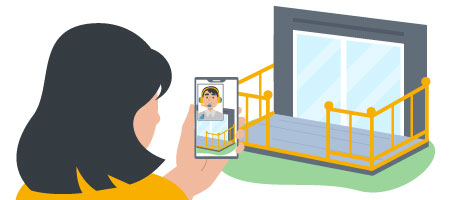
Get help measuring and a free no-obligation quote on a free 20-minute video call from the comfort of your own home. Speak with our expert team about your staircase upgrade.
 BOOK CALL NOW
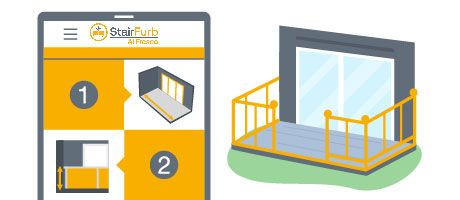
Measure your staircase using our online video tutorials and input them into our online configurator for a free, no-obligation quote. It takes less than 15 minutes.
 START DIY QUOTE
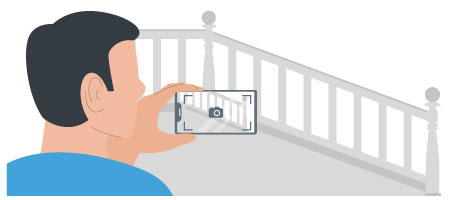
 GET PHOTO ESTIMATE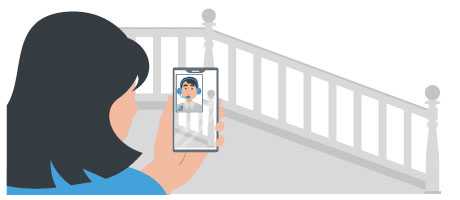
 BOOK CALL NOW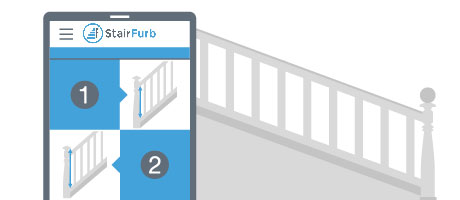
 START DIY QUOTE