

If you’ve ever tried to describe a part of your staircase to a joiner, looked up a product listing for a balustrade kit, or simply wanted to understand what you’re looking at before starting a refurbishment, the terminology can be a real stumbling block.
Words like baluster, spindle, newel, and baserail are often used interchangeably, even by people in the trade. That makes it genuinely difficult to know what you’re ordering or what a quote is referring to.
This guide covers the main parts of a staircase in plain terms. It also addresses the terms that cause the most confusion, and includes a section on which parts are relevant if you’re planning a balustrade refurbishment rather than a full staircase replacement.
These are the structural elements that form the staircase itself. When homeowners refurbish their stairs, these components typically stay in place. It is the balustrade assembly that changes.
Tread The horizontal surface of each step, and the part you walk on. For domestic staircases, UK building regulations specify a minimum going, which is the front-to-back depth of each tread.
Riser The vertical face between one tread and the next. Staircases with riser boards are described as closed-riser; those without are open-riser. The maximum individual rise for a domestic staircase is set out in Part K.
Nosing The front edge of the tread that overhangs the riser below. Nosings make each step edge more visible and provide a small amount of grip underfoot.

Stringer (string) The board running diagonally along the side of the staircase, supporting the treads and risers. There are two main types:
Wall string The stringer fixed flush against the wall, also called the wall-side string.
Landing The flat platform at the top of a flight, or between two flights where the staircase changes direction.

The balustrade is the safety assembly running along the open side of the staircase. It prevents falls and, in domestic properties, must meet minimum height and spacing requirements under UK building regulations.
It is made up of several components, each with a distinct role.
| Part | What it is | Where it sits |
| Newel post | The large structural post that anchors the handrail and balustrade | At the foot, top, and turns of the staircase |
| Newel cap | A decorative top piece fitted to the newel post | On top of the newel post |
| Half newel post | A newel post cut in half lengthways | Where the staircase meets a wall on a landing |
| Handrail | The rail you hold for support, running between newel posts | Along the top of the balustrade |
| Base rail (baserail) | The lower rail that spindles or glass panels fit into | Along the bottom of the balustrade, parallel to the handrail |
| Spindles / balusters | The vertical infill between handrail and base rail | Between newel posts, evenly spaced |
| String capping | A moulding covering the top of the wall-side stringer | Along the wall-side stringer |
| Bullnose step | A rounded first step, often with a curved end | At the bottom of the staircase |

Newel posts are structural, not decorative. They carry the load of the handrail and anchor the whole balustrade system.
They come in two main styles:
Common newel cap styles include ball, acorn, and flat square. The cap is mainly decorative, though it also protects the end grain of a timber newel post.

UK building regulations require that spindles are spaced so that a 100mm sphere cannot pass between them. This is to prevent young children from becoming trapped or falling through the gaps.
Spindles can be made from:
The material you choose affects which type of base rail and handrail system is needed, so it is worth deciding on this before taking measurements.

Several stair parts share similar names or are used interchangeably in everyday speech. Here are the most common ones worth knowing.
These refer to the same component.
The full safety assembly, including handrail, spindles, base rail, and newel posts, is called the balustrade.
In everyday use, most people treat these as the same thing.
In product listings, specifications, and building regulations, handrail is the correct term to use.
Both are vertical elements, which is why they are easily confused. The difference comes down to size and function.
| Newel post | Baluster / spindle | |
| Size | Large | Smaller |
| Function | Structural anchor point | Safety infill |
| Fixed to | Floor, string, or landing | Handrail and base rail |
| Spacing | At key points only | Evenly spaced throughout |
A straightforward way to keep them straight: the tread is what you tread on.
When updating a staircase, most homeowners do not need to touch the structure at all.
The structural parts, including treads, risers, and stringers, almost always stay in place. The refurbishment focuses on the balustrade assembly only.
A typical balustrade refurbishment includes the replacement of:
Made-to-measure balustrade kits are produced to fit your existing staircase dimensions. Components arrive pre-cut and pre-drilled, which removes the need to source and cut individual parts. StairFurb kits include video guides covering each stage of fitting, making the process straightforward for a competent DIYer.
A refurbishment is a practical point to verify whether the existing balustrade meets current regulations. If spindle spacing is wider than 100mm, or the handrail height falls below the required minimum, replacing the balustrade brings the staircase up to standard at the same time.
The material used for spindles and handrails affects both the look of the finished staircase and how components are installed.
Timber
Traditional balustrades use timber spindles, typically in oak or pine, with matching handrails and newel posts. This is an especially popular choice for people with a wood staircase. These suit period properties and more traditional interiors well and can be painted or stained to match existing woodwork.
Metal
Metal spindles, usually in steel or with a wrought iron style finish, offer a more contemporary look while keeping the traditional post-and-rail format. They are often combined with oak handrails and newel posts.
Glass
Glass panels are increasingly used in place of spindles, particularly where homeowners want to open the staircase up visually and allow more light through the space.
Glass used in balustrades must be toughened safety glass.
Each panel is cut to size and polished on all edges. The installation method differs from timber or metal spindles. Glass panels typically sit into a grooved base rail or are held in place with stainless steel clamps fixed to the handrail.



Share pictures of your staircase and we'll provide a quote, plus offer expert help with measurements with a video call.
Grab your tape measure and follow our step-by-step video tutorials to get your quote
Get help measuring and a free no-obligation quote on a free 20-minute video call from the comfort of your own home. Speak with our expert team about your staircase upgrade.
 BOOK CALL NOW
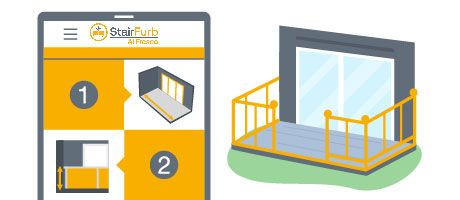
Measure your staircase using our online video tutorials and input them into our online configurator for a free, no-obligation quote. It takes less than 15 minutes.
 START DIY QUOTE

 GET PHOTO ESTIMATE
 BOOK CALL NOW
 START DIY QUOTE